
January 2026
The Step-by-Step Green Tea Production Process
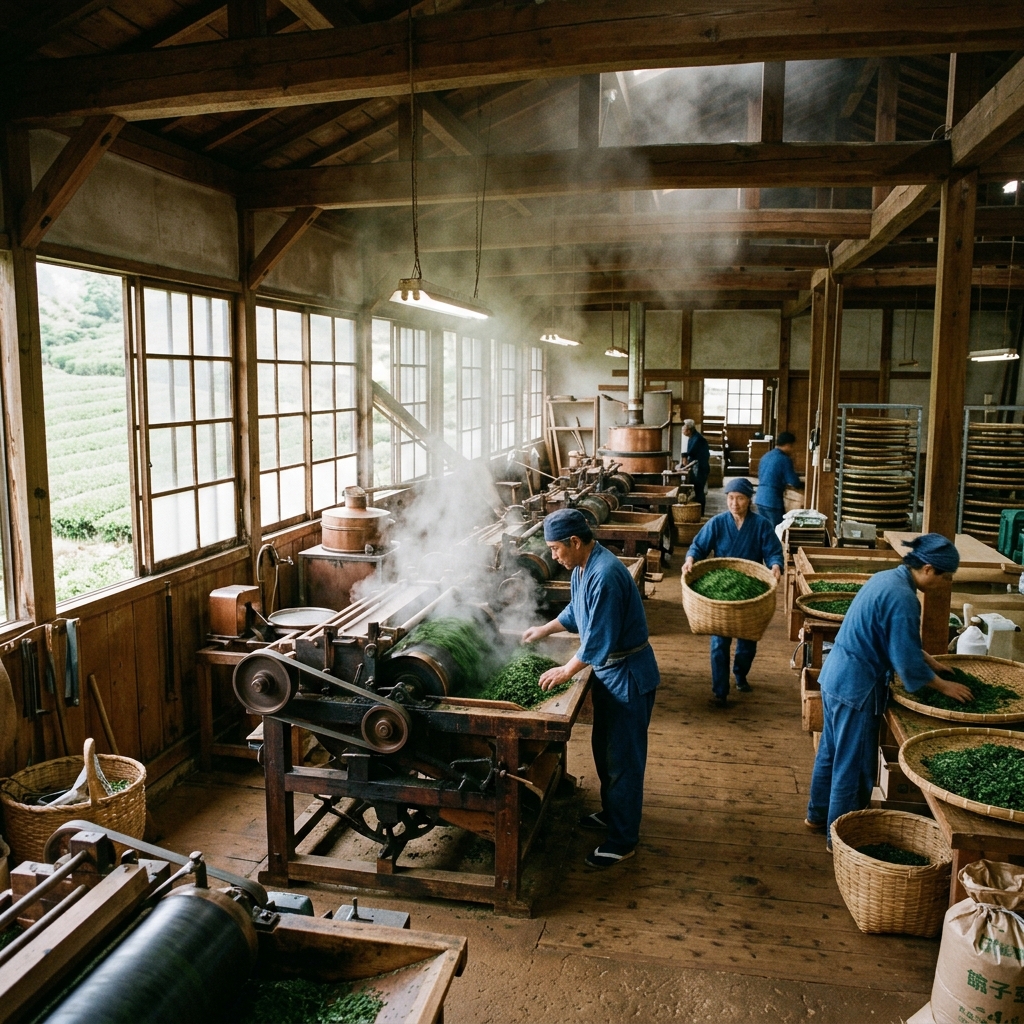
Crafting premium Japanese green tea involves an unbroken sequence of specialized steps designed to preserve vibrant color, complex aromatics, and structural umami.
Phase I: Field Cultivation & Harvesting
Cultivation & Shading: Tea fields require meticulous year-round agricultural management, including targeted fertilizer application, careful pruning, and pest control. In early spring, tender new shoots emerge. For top-tier varieties like Gyokuro or Kabusecha, synthetic or traditional covers are placed directly over the plants before harvest to block sunlight. This crucial shading process drives up the concentration of internal amino acids, which are the primary umami components.
Plucking: Between April and May, the premier spring growth is harvested as the prized "first flush" (shincha). While machine-picking is utilized for commercial volume, ultra-premium grades rely on labor-intensive hand-picking. First flush leaves are universally celebrated for their dynamic fragrance and sweet flavor.
Phase II: Enzymatic Arrest & Rolling
Steaming: Immediately following plucking, natural oxidizing enzymes begin degrading the leaf. To lock in the pristine green color and fresh top-note aromas, the leaves are rapidly steamed to deactivate these enzymes. Teas are classified by their precise steaming duration:
- Light Steaming (Asamushi): Approximately 30 seconds. Yields a light golden-green liquor and a crisp, refreshing flavor profile.
- Standard Steaming (Chumushi): 30 to 60 seconds.
- Deep Steaming (Fukamushi): 60 to 120 seconds. The intense heat breaks down the leaf structure into finer particles, resulting in a deep, opaque green brew with a rich, mellow body.
Cooling: Leaving steamed leaves at elevated temperatures causes rapid discoloration and flavor flattening. The leaves are blasted with room-temperature air to rapidly and uniformly drop their thermal load.
Coarse Rolling: Hot, dry air is introduced under controlled mechanical pressure. The leaves are gently compressed and rubbed together, generating internal friction that softens the cell walls and evaporates surface moisture.
Rolling: Performed without external heat, the leaves are gathered into a solid mass and pressurized. This equalizes moisture distribution across the batch and thoroughly breaks down inner leaf tissues for effortless flavor extraction.
Middle Rolling: As moisture escapes, the leaves shrink and twist. Dry hot air is reintroduced alongside gentle pressure to loosen and shape the twisted foliage.
Phase III: Firing, Refining & Packaging
Firing & Final Rolling: The tea is fired at 80°C to 100°C to stimulate internal aromatic compounds. The foliage is then hand-rolled or mechanically rolled in a continuous single direction to create the classic slender, needle-like shape of authentic green tea.
Drying: Hot air reduces internal moisture levels from 10–13% down to a shelf-stable 5%. At this milestone, the unrefined tea is designated as Aracha (rough or rough-processed tea). Commercial tea manufacturers typically purchase Aracha directly from regional farmers to execute the final finishing stages.
Sorting & Finishing: Aracha undergoes mechanical sifting to separate heavy stems, fine dust, and broken particles from uniform whole leaves. This yields specialized sub-categories like stem tea, powder tea, and leaf tea.
Blending & Packaging: Finished leaf, stem, and raw teas are expertly blended to harmonize flavor and aroma profiles. This refined master product is called Shiage-cha (finished tea). It is immediately flushed with food-grade nitrogen gas and sealed in multi-layer aluminum bags, locking in peak freshness for 6 to 12 months.